Warp + Weft
Rated: Good
Price: $$
Location: USA
Quick verdict
Warp + Weft is best for budget-conscious shoppers seeking sustainably made denim with exceptional size inclusivity (women's 00–24, men's waist 28–48). What stands out is that it's manufactured in the same vertically integrated, family-owned factory as DL1961 (Artistic Denim Mills in Pakistan), meaning you get the same sustainability infrastructure at nearly half the price (~$78–98 vs. DL1961's $158–208). The key caveats: the brand publishes no sustainability report of its own, has no circularity programme, and its connection to DL1961 is underplayed on its own website. You're essentially relying on factory-level certifications rather than brand-level accountability.
Key info
- Headquarters
- New York, NY, USA
- Founded
- 2016
- Product categories
- Denim, Womenswear, Menswear
- Price range
- $$
- Key certifications
- Factory-level: SA8000, OEKO-TEX, GOTS, GRS, BCI, Cradle to Cradle, ZDHC, Higg Index, BSCI, WRAP, Sedex. Brand-level: none
Warp + Weft sustainability rating
Our ratings are based on a scale from 1 (We Avoid) to 5 (Excellent). How we rate
Rating breakdown
Uses cotton meeting at least one of four certifications (GOTS, OCS, BCI, or Recycled Claim Standard), TENCEL™ Lyocell, and DyStar Liquid Indigo dye. The factory has Cradle to Cradle and GRS certification. However, specific proportions of recycled, organic, or conventional cotton are not disclosed for the Warp + Weft line specifically.
Manufactured at Artistic Denim Mills (Ahmed family-owned, Pakistan), which holds SA8000, BSCI, WRAP, Sedex, and Better Work certifications, an impressive roster. However, there is no evidence that workers are paid living wages. SA8000 certification exists but the gap between certified labour standards and verified living wages remains.
Claims less than 10 gallons of water per pair (vs. ~1,500 industry average), 98% water recycled via in-house treatment plant, dry ozone technology, laser finishing, and e-flow nano-bubble technology. Factory generates 200kW solar + 15MW self-powered energy. Deduction for no published carbon emissions targets and no end-of-life/take-back programme.
Vertical integration provides inherent visibility, and the factory is openly the same as DL1961's. But no annual sustainability report, no public code of conduct, no emissions tracking, and the DL1961 connection is underplayed on the brand's website. Not in Fashion Transparency Index and not B Corp certified.
At $78–98 for most jeans, this is the best price-to-sustainability ratio in denim. The same factory, same sustainability technologies, same certifications as $158–208 DL1961 jeans. Undercuts virtually every other sustainable denim brand (Everlane $88–108, Boyish $128–178, Reformation $128–178, Nudie $160–250).
What they do well
- Best-in-class price-to-sustainability ratio. Premium sustainable denim manufacturing at under $100, enabled by vertical integration that eliminates middlemen. The same factory that makes $200 DL1961 jeans produces Warp + Weft at $78.
- Exceptional size inclusivity. Women's 00–24, men's waist 28–48, with over 75 sizes, shapes, and heights represented, specifically addressing the 67% of US women who are size 14+.
- Significant water savings through proprietary technology. Less than 10 gallons per jean with 98% water recycled, ozone technology eliminating harmful bleaching, and laser finishing reducing chemical usage by 90%.
- Complete vertical integration. From spinning yarn to weaving fabric to cut/sew/finish, all in one family-owned facility, a genuine rarity in fashion that reduces transport emissions and enables quality control at every stage.
- Charity: water partnership, matching every $3 donation, with every 5 jeans purchased with a donation providing clean water to one person.
Room for improvement
- Transparency and reporting are the biggest gaps. No sustainability report, no emissions targets, no public code of conduct, no circularity programme. The brand relies entirely on factory-level certifications without publishing brand-level accountability metrics.
- The DL1961 relationship is underplayed. The connection to DL1961 and the Ahmed family is the key reason the brand's sustainability claims are credible, yet it's barely mentioned on the Warp + Weft website. This creates a transparency gap and could read as the brand trying to appear independent.
- No end-of-life strategy exists. No take-back programme, no repair services, no resale platform, no garment recycling initiative. For a brand positioned as sustainable, this is a meaningful omission, especially when competitors like Nudie Jeans offer free repairs for life.
About Warp + Weft
Sarah Ahmed, a denim industry veteran and member of the Ahmed family (which has been in the denim business for 30+ years), founded Warp + Weft in 2016 with a straightforward premise: "Great-fitting, high-quality jeans were only available to a few." Ahmed also served as Creative Director, and at times CEO, of DL1961, the family's premium denim brand. Both brands share the same New York headquarters at 121 Varick St, Floor 4.
The critical thing to understand about Warp + Weft is that it is manufactured at Artistic Denim Mills (ADM) in Pakistan, the same family-owned, vertically integrated facility that produces DL1961. This factory holds an impressive array of certifications: SA8000, OEKO-TEX, GOTS, GRS, BCI, Cradle to Cradle, ISO 9001, ZDHC, Higg Index, BSCI, WRAP, Sedex, and Better Work. The facility uses dry ozone technology (waterless bleaching), laser finishing (reduces chemicals by 90%), e-flow nano-bubble technology (reduces water up to 95%), and DyStar Liquid Indigo dye. It generates 200kW from solar panels plus 15MW of self-powered energy with heat recovery, and operates an in-house water treatment plant that recycles 98% of water used.
However, these are factory-level certifications. Warp + Weft the brand holds no independent certifications (not B Corp, not in Fashion Transparency Index). DL1961, which uses the same factory, received an overall "It's a Start" rating with Planet 4/5 but People only 2/5. Cotton is certified under at least one standard (GOTS, OCS, BCI, or Recycled Claim Standard), but specific proportions are not disclosed for the Warp + Weft line.
Shipping offers free ground on orders over $100 (US), with a 15-day return window. Pricing runs $78–98 for most jeans, $54 for shorts, and $78–98 for jackets, dramatically below DL1961's $158–208 range and most sustainable denim competitors. The tradeoff versus DL1961 is simpler styling, fewer trend-forward silhouettes, and less premium finishing. What you gain is the same factory sustainability at nearly half the price, with substantially wider size inclusivity.
Product highlights
ASE High Rise Straight
Vintage-inspired straight-leg in "New Girl With An Old Soul" fabric (98% cotton, 2% elastane)
~$98
Bestseller praised for out-of-the-box comfort, true-to-size fit, and colour retention; exemplifies the brand's "essential denim" positioning
MIA High Rise Flare
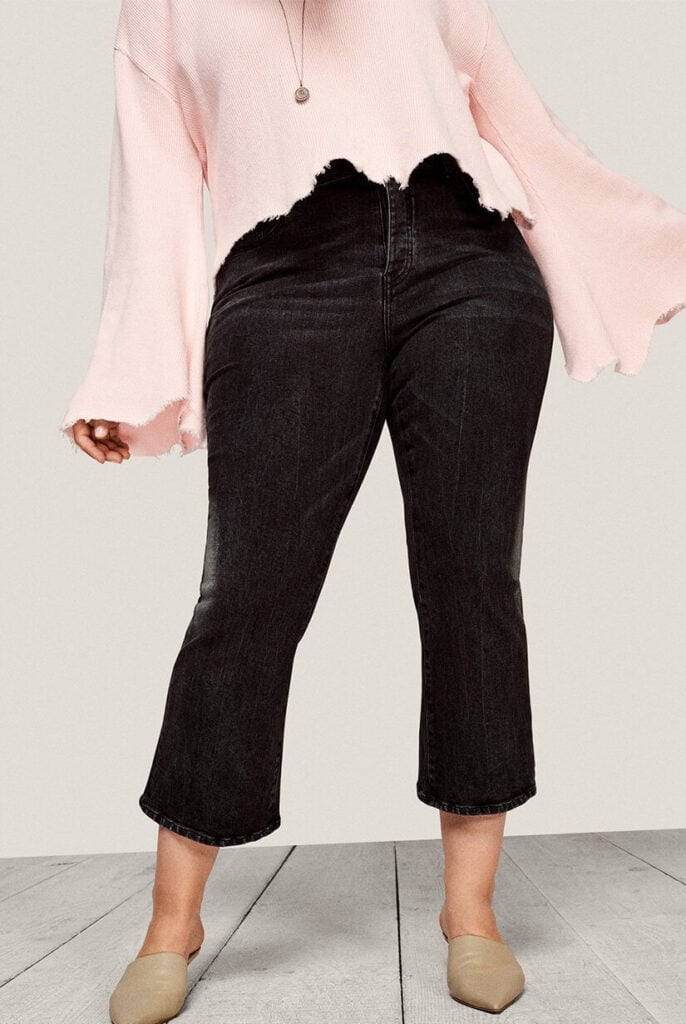
Leg-lengthening flare available in both regular (00–14) and plus (14W–24W) sizing
~$78
Featured by Insider as one of the best plus-size jeans; demonstrates genuine size inclusivity at a sustainable price point
LBC Denim Jacket
Classic denim jacket available in plus sizes, sustainably made at Artistic Denim Mills
~$98
Shows category expansion beyond jeans; also available at Verishop and Bloomingdale's
NAO PLUS High Rise Bootcut
Fresh bootcut in sculpting stretch denim (99% cotton, 1% Lycra) in plus sizing 14W–24W
~$78
Excellent example of trend-responsive, size-inclusive sustainable denim at the lowest price tier
![8 Best Vegan Jeans For a Cruelty-Free Closet [2026]](/images/blog/vegan-jeans.webp)