Native Shoes
Rated: Great
Price: $
Location: Canada
Quick verdict
Native Shoes is best for families and casual-shoe buyers wanting lightweight, washable, affordable shoes with genuine environmental innovation behind them. What stands out is their material R&D leadership (from sugarcane-EVA blends (Sugarlite) to algae-based foam (Bloom) to the world's first fully compostable sneaker (The Plant Shoe)) plus the tangible community impact of their Remix Project (40,000+ shoes recycled into playground surfaces). The significant caveat: labour practices are weak, with manufacturing in China and Vietnam and no living-wage evidence or published Code of Conduct.
Key info
- Headquarters
- Vancouver, Canada
- Founded
- 2009
- Product categories
- Shoes
- Price range
- $
- Key certifications
- PETA-Approved Vegan ("Beast Free"), SBTi-Approved Science-Based Targets, Canopy Pack4Good
Native Shoes sustainability rating
Our ratings are based on a scale from 1 (We Avoid) to 5 (Excellent). How we rate
Rating breakdown
Proprietary Sugarlite (sugarcane + EVA, 22% fewer emissions than standard EVA), Bloom algae-based foam (cleans ~80 litres of water per shoe), Vibram Ecostep Natural (90%+ natural ingredients), recycled rubber, and the Plant Shoe (100% plant-based, compostable in ~45 days). Core material remains EVA, which is still petrochemical-derived.
Manufacturing in China and Vietnam, countries classified as extreme risk for labour abuse. There is no Code of Conduct, no living-wage evidence, and only "some" supply chain tracing. No factory list published. This is the brand's weakest area.
SBTi-approved science-based targets with product-level carbon data (Jefferson Sugarlite: 3.75 kg CO₂e per pair). The Remix Project has recycled 40,000+ shoes into 6 community playgrounds. Canopy Pack4Good partnership addresses deforestation. But no water-reduction initiatives or hazardous-chemical policy.
Publishes some carbon data and a Scope 1/2/3 breakdown on their climate page. SBTi commitment is publicly verifiable. But no factory list, no comprehensive sustainability report, no Code of Conduct, and limited information on wages and conditions in Chinese/Vietnamese factories.
The most accessible brand in this roundup, core Jefferson at $55–60, kids' shoes at ~$35–50, boots at $80–150, Significantly cheaper than Allbirds, Veja, and most certified sustainable shoe brands. Exceptional value given the material innovation, though some durability concerns exist with EVA's heat sensitivity.
What they do well
- The Remix Project: a concrete, measurable circularity programme in partnership with Zappos for Good that has recycled 40,000+ pairs into playground flooring and community infrastructure, with 6 playgrounds built to date
- Product-level carbon data: one of very few shoe brands publishing specific CO₂e figures per product (Jefferson Sugarlite at 3.75 kg CO₂e), backed by SBTi-approved science-based targets and BMO Radicle carbon accounting software
- The Plant Shoe: the world's first 100% plant-based, fully compostable modern sneaker (decomposes in ~45 days), made from pineapple husk, eucalyptus, cork, sisal, corn, and natural rubber, shortlisted for a Dezeen Award
- Family-friendly pricing: roughly 50% of production is dedicated to kids' shoes, and the Jefferson is Zappos' top-selling children's shoe, making sustainability accessible for families
Room for improvement
- Labour practices are the critical gap, manufacturing in China and Vietnam with no published Code of Conduct, no living-wage evidence, no factory list, and only partial supply chain tracing. Pebble Magazine flagged uncertainty about "what ethical protections are in place."
- EVA is still plastic, the core product line relies on ethylene vinyl acetate, a petrochemical-derived material. Sugarlite blends in sugarcane but is not fully bio-based. Some customers report shoes warping or melting when left in direct sunlight, a known EVA limitation.
- 2023 lifecycle goal appears unmet, Native Shoes pledged that by 2023 all shoes would be "100% lifecycle managed" (compostable or recyclable), an ambitious target that does not appear to have been fully achieved.
About Native Shoes
Native Shoes was founded in 2009 in Vancouver by Scott Hawthorn and co-founders with a deceptively simple idea: take the lightweight, injection-moulded EVA material (popularised by Crocs) and craft it into forms inspired by classic sneaker silhouettes like Vans and Converse. The brand debuted with the Jefferson and Fitzsimmons, both still in the range today.
By 2013, the company was struggling financially before pivoting toward purpose under the "Live Lightly" philosophy and hiring former Lululemon executive Kyle Housman. This reorientation produced a wave of material innovation: Sugarlite (sugarcane + EVA blend producing 22% fewer greenhouse gas emissions), Bloom (algae-based foam that cleans ~80 litres of water per shoe), and the landmark Plant Shoe, a 100% plant-based, compostable sneaker made from pineapple husk, eucalyptus, cork, sisal, corn, and natural rubber that decomposes in approximately 45 days. The Plant Shoe was shortlisted for a Dezeen Award in 2019.
The Remix Project, launched in 2018 with Zappos for Good, collects worn-out Native Shoes and grinds them into material for playground surfaces and community seating, 40,000+ pairs recycled and 6 playgrounds built to date. The brand has also committed to SBTi-approved science-based targets and uses BMO Radicle carbon accounting software to track emissions.
Manufacturing takes place in factories in China and Vietnam producing close to 2 million pairs annually. This is where the brand is most vulnerable to criticism: there is no Code of Conduct or living-wage evidence. Pricing is highly accessible, the core Jefferson runs $55–60 for adults and ~$35–50 for kids, making it one of the most affordable sustainable shoe brands on the market. Native Shoes sells in 45+ countries via its own stores (Vancouver, Nantucket, San Jose), Nordstrom, Zappos, and Amazon. Ecothes has featured the brand across sustainable sandals, kids' shoes, knit shoes, and sneakers roundups.
Product highlights
Jefferson Sugarlite
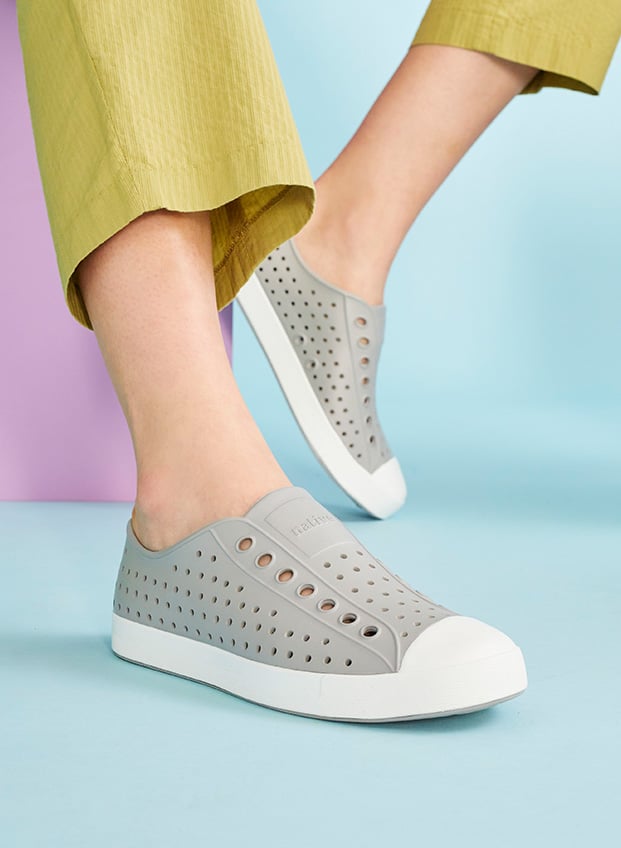
Iconic perforated slip-on sneaker in sugarcane-EVA blend, dozens of colours
~$55–60
Just 3.75 kg CO₂e per pair, one of the lowest-impact shoes on the market; top-selling kids' shoe on Zappos
The Plant Shoe
100% plant-based sneaker: pineapple husk, eucalyptus, cork, sisal, corn, natural rubber. Fully compostable in ~45 days
~$200
The world's first compostable modern sneaker, a design and sustainability landmark shortlisted for a Dezeen Award
Fitzsimmons Venture
Hiking-style boot with Vibram Ecostep Natural outsole (90%+ natural ingredients), Bloom algae upper, microfleece lining
~$150
The brand's premium offering, pairing Vibram's most sustainable outsole with algae-based materials
Fitzsimmons Citylite Bloom
Hiking-style boot with algae-infused Bloom upper and sole, microfleece lining
~$80–115
More affordable Bloom boot for urban use, tangible algae-cleaning impact at a mid-range price

![9 Best Sustainable Shoes Like Crocs: Eco-Friendly Crocs Alternatives [2026]](/images/blog/shoes-like-crocs.webp)
![10 Best Sustainable Birkenstock Alternatives & Dupes [2026]](/images/blog/sandals-like-birkenstock.webp)