Filippa K
Rated: Good
Price: $$$
Location: Sweden
Quick verdict
Filippa K is best for fans of Scandinavian minimalist design who want wardrobe staples built to last and are willing to pay premium prices. The brand stands out as one of fashion's earliest movers on circularity, with genuine programmes for resale, repair, and garment take-back dating to 2015. The key caveat: there's no evidence workers across its supply chain earn living wages, and the brand uses leather, silk, and shearling without a formal animal welfare policy.
Key info
- Headquarters
- Stockholm, Sweden
- Founded
- 1993
- Product categories
- Womenswear, Menswear, Minimalist
- Price range
- $$$
- Key certifications
- GOTS, OEKO-TEX, Bluesign, GRS, RWS, RMS, RDS, Fair Wear Foundation member since 2008
Filippa K sustainability rating
Our ratings are based on a scale from 1 (We Avoid) to 5 (Excellent). How we rate
Rating breakdown
In 2024, 52% of all main fibres were "preferred materials" including organic cotton, TENCEL Lyocell, recycled polyester, and innovative fabrics like CIRCULOSE® (made from discarded textiles in Sweden). The brand's Swedish Wool initiative and QR-coded fibre traceability programme show genuine material innovation, though a significant portion of materials remain conventional.
A Fair Wear Foundation member since 2008 with a "Good" performance check rating in 2024, Filippa K discloses 100% of production locations across Tiers 1–3. Manufacturing spans Portugal, Italy, China, Turkey, Romania, and others. However, no evidence exists that workers are paid living wages, a policy has been created but not implemented.
The brand has conducted carbon footprint assessments, uses FSC-certified packaging, and runs a robust circularity ecosystem. However, there is no evidence Filippa K is on track to meet its own GHG reduction target, it hasn't committed to eliminating all hazardous chemicals, and it doesn't yet disclose water consumption data from manufacturing.
This is where Filippa K genuinely excels. It publishes 87+ page annual sustainability reports (GRI-aligned since 2021), shares factory lists at Tiers 1–3, uses TrustTrace for supply chain mapping to Tier 4, and launched a QR-code fibre traceability initiative in 2024. It scored "Certified" (the top tier) on Eco-Stylist. The brand is preparing for EU CSRD reporting and Digital Product Passports.
Pricing is firmly premium: $85 for a basic organic cotton tee, $310 for trousers, $480+ for outerwear. This positions Filippa K alongside Acne Studios and COS at the higher end. The "Core Collection" pieces never go on sale, which supports the longevity philosophy but limits accessibility. Quality reviews are mixed: knitwear is praised, but some customers report basics deteriorating within months.
What they do well
- Circularity pioneer. Filippa K Collect (garment take-back since 2015), Preowned resale via Mai, Care & Repair guidance, and FK Studio for remaking past-season pieces form one of fashion's most complete circular ecosystems.
- Industry-leading transparency. Factory lists published at Tiers 1–3, TrustTrace mapping to Tier 4, and a fibre traceability initiative with QR codes enabling farm-to-hanger tracking on wool garments.
- Material innovation. Early adopter of CIRCULOSE® (recycled textile fibre made in Sweden), Swedish Wool (a byproduct previously going to waste), and co-developer of the Responsible Mohair Standard.
- Fair Wear Foundation commitment. 16+ years of membership with steadily improving performance check scores, providing third-party accountability for labour practices.
- Season-less Core Collection. Permanent staples designed for maximum wears that never go on sale, reinforcing the brand's anti-overconsumption philosophy.
Room for improvement
- Living wages remain unimplemented. Despite creating a living wage policy, there is no evidence it has been rolled out across the supply chain, a gap flagged by Eco-Stylist and Fair Wear Foundation alike.
- Animal welfare needs work. Filippa K uses leather, shearling, silk, and exotic animal hair without a formal animal welfare policy.
About Filippa K
Filippa Knutsson founded Filippa K in Stockholm in 1993 with a vision of Scandinavian simplicity, "the purest form of luxury." The brand has grown to 34 stores and over 450 retail partners across 20+ markets, anchored by a design philosophy that prizes timelessness over trend. Its material mix includes GOTS-certified organic cotton, TENCEL Lyocell, recycled polyester, and innovative fabrics like CIRCULOSE® (100% recycled from discarded textiles) and Swedish Wool sourced from farms in Kungör.
Manufacturing takes place across Portugal, Italy, China, Turkey, Romania, and several other countries, all disclosed through the Fair Wear Foundation's transparency portal. The brand holds certifications including GOTS, OEKO-TEX, Bluesign, GRS, Responsible Wool Standard, and Responsible Down Standard. It co-developed the Responsible Mohair Standard in 2019 alongside Acne Studios and John Lewis.
While not B Corp certified and not large enough for the Fashion Transparency Index (which requires $400M+ revenue), Filippa K publishes comprehensive GRI-aligned sustainability reports and maps its supply chain to Tier 4 via TrustTrace. Shipping is available globally through its e-commerce site. Returns policies vary by market, though customer reviews suggest the returns process can be frustrating.
Pricing sits at the high end of the accessible luxury spectrum, comparable to Acne Studios and above COS, with tees starting around $85 and outerwear reaching $900.
Product highlights
M. Single Jersey Tee
100% organic cotton crew neck, OEKO-TEX certified
~$85
Core Collection staple available in 12+ colours; knit in Portugal with single-needle stitching
Milo Trousers
Suiting wool blend, wide-leg, mid-waist
~$310
An "Icon" piece designed for a full suit pairing with the Michael Blazer
Darcey Trousers
Recycled wool-blend twill, high-rise, wide-leg
~$250–$295
Made in Portugal from recycled wool; a key women's Icon piece
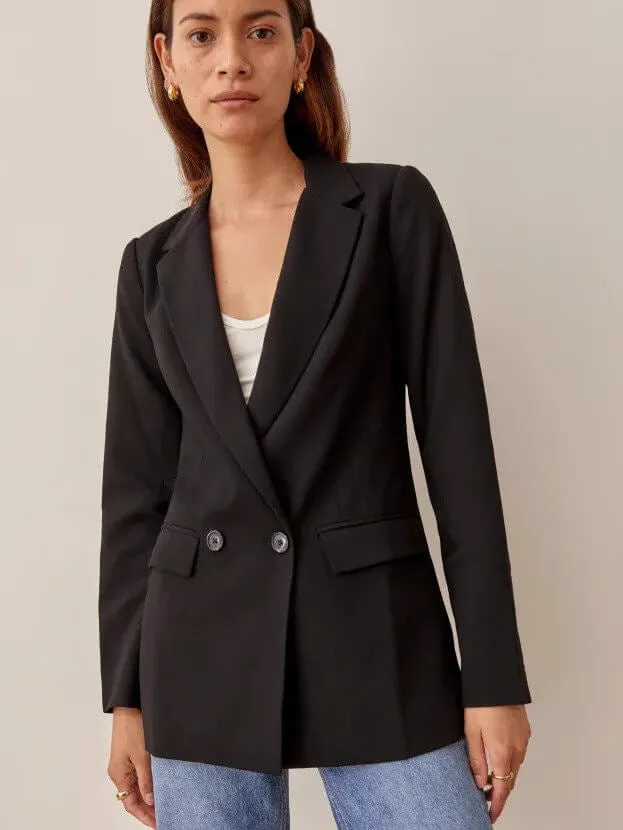
Taylor Jacket
Tailored outerwear in 4+ colourways
~$480
Versatile layering piece bridging casual and tailored aesthetics