
40 Sustainable Fashion Facts & Statistics [2026]
We carefully vet all products and brands featured on Ecothes using our rating guidelines. We may earn a commission at no extra cost to you if you buy through our links.
The fashion industry remains one of the most polluting industries in the world — but regulation, resale, and consumer awareness are starting to shift the picture.
From a 7.5% spike in emissions to the EU banning the destruction of unsold clothing, 2025 and 2026 have brought major developments. We’ve compiled 40 of the most important sustainable fashion facts and statistics, updated with the latest data.
General sustainable fashion facts
-
The fashion industry produced 944 million tonnes of CO2 equivalent in 2023 — roughly 2% of global greenhouse gas emissions — and that figure rose 7.5% from the prior year, the first increase since 2019.
-
As much as 20% to 35% of all primary source microplastics in the marine environment come from synthetic clothing, according to academic estimates.
-
The sustainable fashion market is valued at approximately $9.19 billion in 2025 and is growing at roughly 10% per year — up to 10 times faster than the overall apparel industry.
-
85% of all textiles produced end up in landfills or are incinerated each year. Only 12% are reused, and less than 1% are recycled into new garments.
Where do our textiles end up?
-
73% of millennials say they are willing to pay more for sustainable brands, making younger consumers the strongest driver of demand for ethical fashion.
-
Less than 2% of garment workers worldwide earn a living wage, despite the fashion industry being worth $2.4 trillion globally.
-
59% of sustainability claims made by fashion brands in 2024 were found to be vague, misleading, or unverifiable, according to a Changing Markets Foundation report.
-
Global fiber production reached 132 million tonnes in 2024 and is expected to grow to 169 million tonnes by 2030, with the biggest increase coming from fossil fuel-based synthetics.
Production stage
-
Producing one cotton t-shirt requires approximately 2,700 liters of water — enough for one person to drink for 900 days.
-
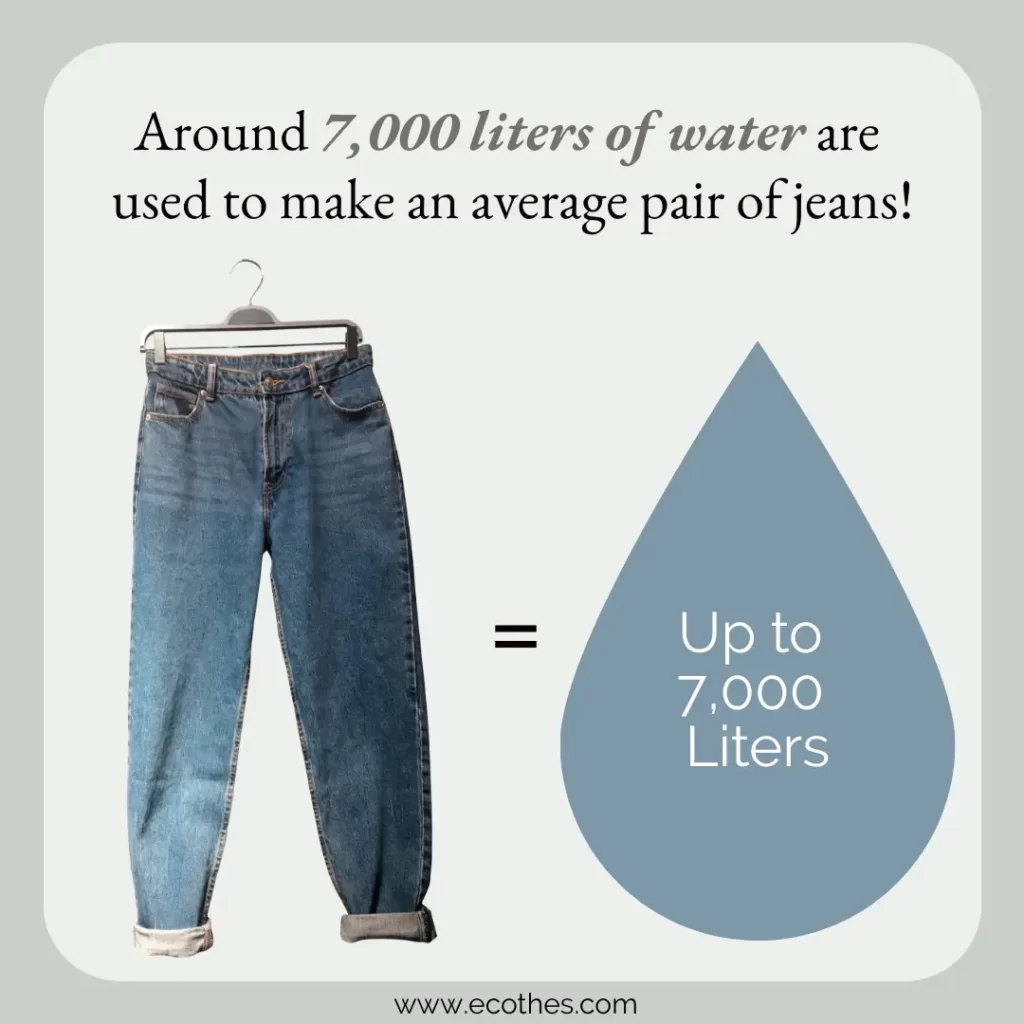
A single pair of jeans requires between 3,781 and 7,500 liters of water to produce, depending on whether the full cotton-growing lifecycle is included.
-
Under 1% of the material used to produce clothing is recycled into new clothing at the end of its life. The vast majority is downcycled into insulation, rags, or lost entirely.
-
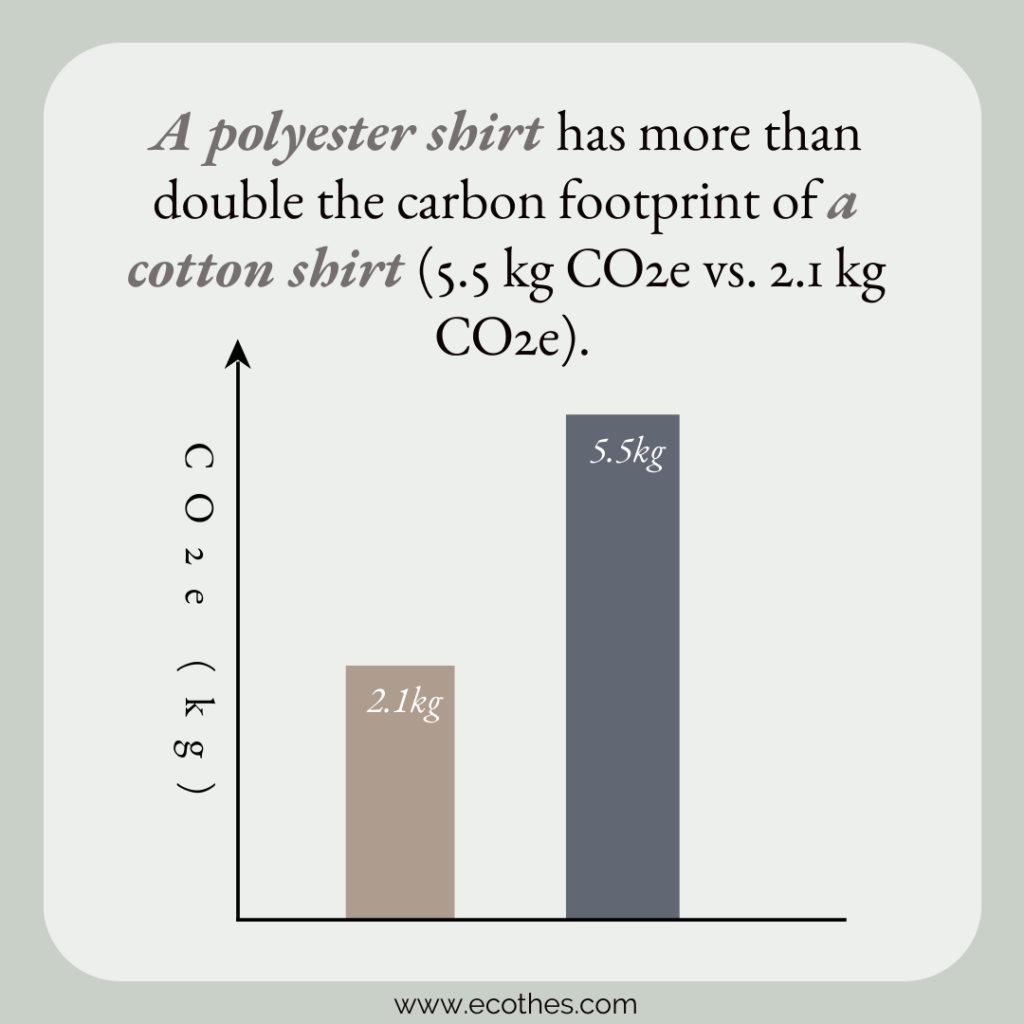
A polyester shirt has more than double the carbon footprint of a cotton shirt (5.5 kg CO2e vs. 2.1 kg CO2e).
-
Textile dyeing is the second-largest polluter of water globally, after agriculture, and is responsible for 20% of industrial wastewater worldwide.
-
Up to 20–30% of fashion production — as many as 30 billion pieces — goes unsold each year. The value of disposed unsold inventory is estimated at $500 billion.
-
Cotton covers just 2.4% of the world’s cropland, yet is responsible for 22.5% of global insecticide use, contributing to a 40% decrease in pollinator populations in key production regions.
-
Over 150 million trees are cut down every year to produce viscose and other cellulosic fibers, with around 30% of that wood sourced from endangered forests.
-
As much as 90% of textile dyes are discharged into rivers unchanged, even after wastewater treatment — with factories in Dhaka, Bangladesh alone releasing 22,000 tons of toxic waste into waterways every year.
-
The fashion industry is projected to use 35% more land for fiber production by 2030 — an extra 115 million hectares that could otherwise be left for biodiversity or used to grow food.
Consumer stage
-
Worldwide clothing utilization has dropped by 36% compared to 15 years ago — we buy more but wear each item far less.
-
68% of Gen Z and Millennials bought secondhand apparel in 2024, helping push resale into the mainstream.
-
Extending the life of clothing by just nine months could reduce carbon, waste, and water footprints by around 20–30% each. Check out our guide to the Best Online Thrift Stores here.
-
3 out of 5 new items of clothing are thrown away or incinerated within one year of purchase.
-
In the US alone, 11.3 million tons of textile waste are sent to landfills per year — that’s 81.5 pounds per person. Only 15% is recycled.
-
The EU generates approximately 12.6 million tonnes of textile waste per year, of which about 5.2 million tonnes are clothing and footwear.
-
60% of global consumers say they are likely to shop resale in 2026, with particularly strong adoption in Asia.
Microplastics & ocean pollution
-
Around 500,000 tons of microfibers enter the ocean every year from washing synthetic clothes — the equivalent of 50 billion plastic bottles.
-
35% of microplastics in the ocean come from synthetic textiles, making fashion the single largest source of microplastic pollution by some estimates.
-
A single 6 kg load of polyester laundry releases approximately 496,030 microplastic particles — and polyester sheds microfibers at six times the rate of nylon.
-
Microplastics have been found in 99% of seafood samples tested, with textile fibers making up over 80% of detected particles. The average person ingests between 78,000 and 211,000 microplastic particles per year.
-
Polyester now accounts for 57–59% of global fiber output, with 88% of that derived from fossil fuels. Recycled polyester makes up just 12% of total polyester production, and 98% of it still comes from plastic bottles rather than textile-to-textile recycling.
Circular fashion & resale
-
The global secondhand apparel market is valued at approximately $350 billion in 2025 and is projected to reach $367 billion by 2029.
-
The US secondhand market grew 14% in 2024 — five times faster than broader retail clothing — with online resale growing 23% and expected to nearly double by 2029.
-
Secondhand luxury boomed 35% in 2025, fueled by a shifting economy and growing cultural acceptance of pre-owned goods.
-
The secondhand market is growing 2–3 times faster than first-hand fashion through 2027, with platforms like Vinted and The RealReal achieving profitability.
-
Moving to a circular textile system could unlock a $560 billion economic opportunity and create 180,000 new jobs, according to the Ellen MacArthur Foundation.
-
The global online clothing rental market reached $1.89 billion in 2025 and is projected to grow to $2.73 billion by 2031.
Regulation & policy
-
The EU adopted mandatory textile Extended Producer Responsibility (EPR) in October 2025, requiring member states to establish producer-funded collection and recycling schemes by June 2027.
-
Starting in 2026, the EU bans the destruction of unsold clothing and footwear under the Ecodesign for Sustainable Products Regulation (ESPR).
-
France became the first country to ban ultra-fast fashion advertising from January 2026, and imposed an eco-tax starting at €5 per item (rising to €10 by 2030) — directly targeting companies like Shein and Temu.
-
The EU’s Empowering Consumers Directive, which bans vague sustainability claims like “eco-friendly” and “green” without evidence, takes effect in September 2026.
Key upcoming fashion regulation deadlines
Sustainable fashion facts takeaways
These numbers paint a clear picture: the fashion industry’s environmental footprint is enormous, but momentum is building in the right direction. Secondhand is booming, regulations are tightening, and consumers — especially younger generations — are demanding change.
The most impactful things you can do as a consumer are to buy less, choose well, and make it last. If you’re looking for brands to avoid, discover the best affordable sustainable clothing brands here.
We also collected a complete list of the best TED Talks on Sustainable Fashion, which is a great resource to learn more.
![31 Eye-Opening Fast Fashion Statistics [2026]](/images/blog/fast-fashion-statistics.webp)